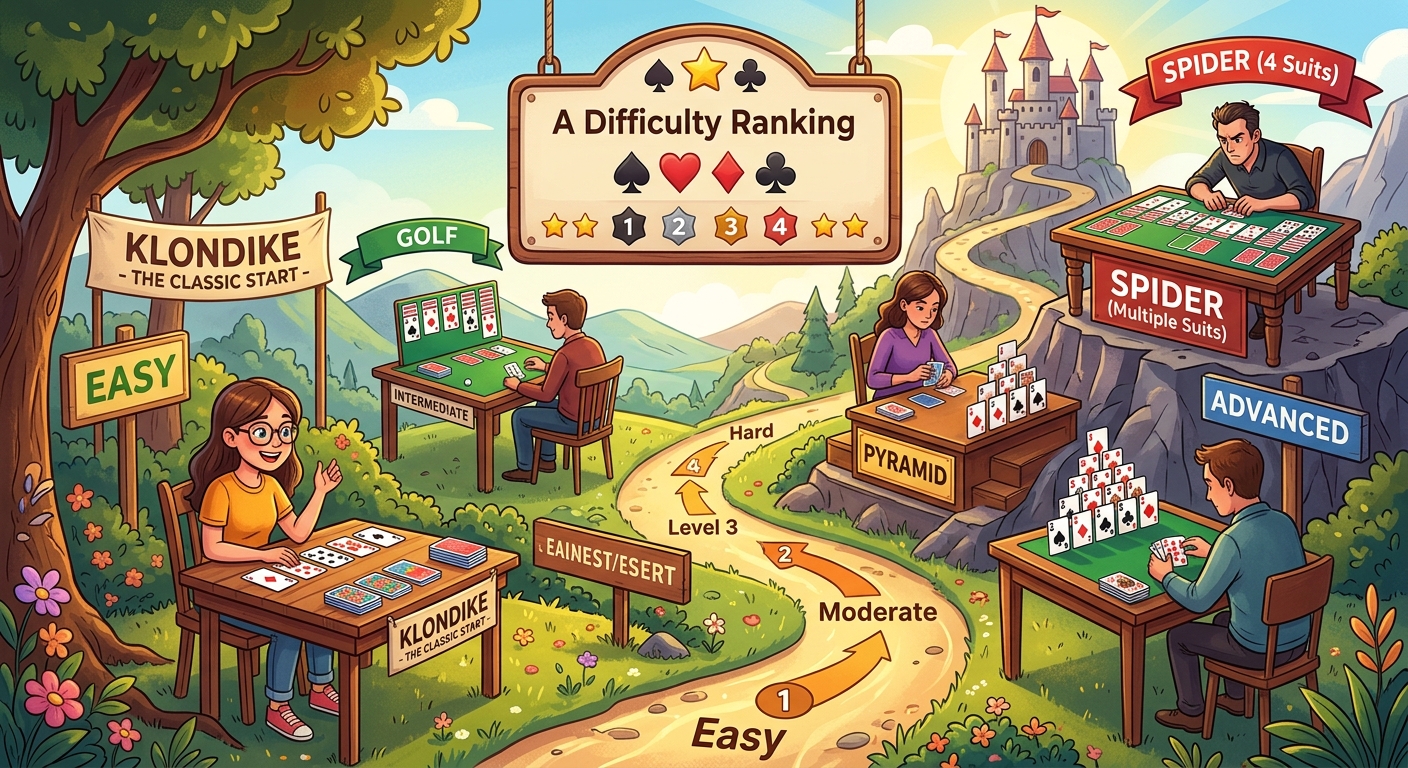
Sitting down to play solitaire for the first time feels simple enough. You pick a game, deal the cards, and start moving things around. Then you realize some versions practically hand you a win, while others leave you staring at the board wondering where everything went wrong. The good news is that the gap between them is predictable. Once you know what to expect, you can pick a game that matches your mood and your patience level on any given day.
This ranking covers seven well-known solitaire variants, arranged from the most forgiving to the most mentally demanding. If you want to pull up any of these and play along, there are free Solitaire games waiting in your browser right now, no download required. Try them as you read.
Solitaire variants range from luck-heavy and forgiving to strategy-heavy and demanding, and knowing where each one sits changes how you approach the whole genre.
- Luck dependency, card visibility, and planning depth are the three factors that define how hard a variant feels.
- Win rate alone does not tell the full story. Some games are hard because strategy matters; others are hard because the deal simply stacks against you.
- Starting with a forgiving variant builds intuition that transfers directly to harder games.
The Three Factors That Define How Hard a Solitaire Game Feels
Not all difficulty works the same way in solitaire. Some games are hard because luck dominates the deal and there is not much you can do once the cards land. Others are hard because the rule set layers on complexity. The most satisfying ones are hard because they reward careful thinking and punish careless moves.
Three things tend to shape how challenging a variant feels. First, there is luck dependency, meaning how much the initial deal controls your fate before you play a single card. Second, there is card visibility, meaning how many cards you can see and use to make informed decisions. Third, there is planning depth, meaning whether you need to think one move ahead or ten. Keep those three in mind as you read through each game.
Golf Solitaire Is the Most Forgiving Place to Begin
Golf Solitaire earns its place at the easy end of this ranking for good reason. The rules are stripped back and clear. You deal cards into columns, then move them onto a single foundation pile by going one step up or down in value, regardless of suit. The game moves fast, the decisions feel manageable, and even when you lose, you understand exactly why.
Win rates in Golf sit somewhere around 40 to 50 percent depending on the variation. That is not exceptional by any measure, but the rounds are short enough that starting a fresh game feels natural rather than discouraging. For someone who has never played solitaire at all, Golf is a confident, low-stress first step that teaches the core idea of card sequencing without overwhelming you.
Pyramid Solitaire Is Simple to Learn and Fast to Play
Pyramid looks almost too easy at first glance. You build a triangle of cards and then try to pair them so they add up to 13. Kings go alone, queens and aces pair together, and so on down the line. The concept is clean, the setup looks appealing, and the goal is immediately obvious.
What catches people off guard is how low the win rate actually is. Pyramid wins come in somewhere around 5 to 15 percent depending on the ruleset, which is far lower than it looks from the outside. That sounds discouraging, but the game stays enjoyable because each round wraps up quickly and each deal feels like a fresh puzzle. You are never far from trying again. The low win rate becomes part of the appeal rather than a wall in front of you.
Klondike Sits at the Center of the Difficulty Spectrum for Good Reason
Klondike is the version most people picture when they hear the word solitaire. Seven columns of cards, a draw pile, four foundation piles building from ace to king. It was the default game on Windows computers for years, and it earned that position by teaching the core logic of the genre without overwhelming a new player.
Difficulty in Klondike lands right in the middle of the spectrum. Draw-one mode is more forgiving and gives you a better shot at clearing the board. Draw-three mode adds a layer of constraint that makes the game genuinely trickier. Either way, Klondike rewards a basic understanding of sequencing and color alternation. You do not need to plan five moves ahead, but thinking two or three makes a noticeable difference. It is the reference point that every other variant on this list is measured against.
Spider One-Suit Is the First Real Step Up in Complexity
Spider Solitaire played with a single suit is a natural next challenge once Klondike starts feeling comfortable. The layout is larger, with ten columns instead of seven, and the goal is to build complete sequences from king down to ace within the tableau before moving them off the board. There is more to track, and mistakes compound faster than they do in Klondike.
Playing with one suit keeps the matching logic simple. Every card looks the same at a glance, so your attention shifts toward building clean runs and keeping columns from jamming up entirely. Spider One-Suit teaches sequence management in a way that nothing else in the beginner range quite matches. Win rates for attentive players hover around 50 to 60 percent, which keeps the challenge real without making the game feel hopeless.
Yukon Turns Klondike into a Genuine Test of Decision-Making
Yukon uses a layout similar to Klondike but removes the draw pile entirely. Every card is dealt face-up into the tableau from the start. That sounds helpful, since you can see everything, but it creates a different kind of pressure. With no draw pile to cycle through, you work only with what is already in front of you. Every move carries more weight.
The distinctive rule in Yukon is that you can move groups of cards that are not in sequence, as long as the card you are moving onto is the right color and one rank higher. That opens up the board in ways Klondike never allows, but it also creates a sprawling range of possible moves that requires real attention to manage. Yukon is a game that rewards experience. New players often stall out quickly, while players who have spent time with Klondike find it deeply satisfying.
FreeCell Is Demanding but Rewards Every Minute You Put Into It
FreeCell is famous for one remarkable fact. Researchers and computer scientists have analyzed the full set of standard FreeCell deals and confirmed that almost no deals in the standard set are genuinely unsolvable. That means when you lose at FreeCell, the loss almost always belongs to you and not to the deck. That is both motivating and humbling in equal measure.
The game gives you four free cells, holding spaces where you can park individual cards while you reorganize the board. Managing those four spaces without locking yourself into a dead end is the central challenge. You need to look ahead, think about which cards will need to move later, and resist the urge to fill all four free cells at once. Players who enjoy a puzzle that rewards methodical thinking tend to love FreeCell. Players who want something lighter often find it exhausting. There is no middle ground.
Canfield Is the Most Demanding Game in This Lineup
Canfield sits at the hard end of this ranking, and the numbers back that up. Most estimates put the win rate somewhere between 5 and 8 percent even for experienced players. The rules are deceptively simple, a reserve pile, four columns, four foundations, and a draw pile, but the starting setup limits your options from the very first card you touch.
What makes Canfield genuinely difficult is the combination of restricted moves and tight sequencing. Empty columns can only be filled from the reserve pile, which removes the flexibility that makes other games feel open and workable. Canfield is fascinating to study, but it is a game best approached with realistic expectations. Wins feel meaningful precisely because they are rare.
How These Seven Variants Compare at a Glance
| Game | Approx. Win Rate | Thinking Required | Best For |
|---|---|---|---|
| Golf | 40, 50% | Low | Complete beginners |
| Pyramid | 5, 15% | Low to moderate | Casual puzzle lovers |
| Klondike | 20, 40% | Moderate | All skill levels |
| Spider One-Suit | 50, 60% | Moderate | Players ready to level up |
| Yukon | 65, 75% | Moderate to high | Experienced Klondike players |
| FreeCell | ~99% (theoretical) | High | Methodical thinkers |
| Canfield | 5, 8% | High | Challenge seekers |
Where to Start and Which Direction to Grow
If you want to win often and get the basics of card sequencing into your muscle memory, Golf and Klondike are the clear starting points. Golf keeps rounds short and satisfying. Klondike teaches the building blocks that appear in almost every other solitaire variant you will ever try. Time spent in either game is never wasted.
If you enjoy the feeling of cracking a puzzle without getting buried in complexity, Pyramid and Spider One-Suit both deliver that. Pyramid is fast enough that a bad run costs you nothing but two minutes. Spider One-Suit builds real strategy habits that transfer directly to harder games. The jump from Klondike to Spider One-Suit is probably the single most rewarding move a beginner can make.
If you are someone who likes sitting with a problem and working it through carefully, FreeCell is one of the most rewarding card games in the entire solitaire family. The near-total solvability rate means you are never fighting a stacked deck. You are working through a logic problem with cards, and that distinction matters. Every loss teaches you something specific.
Yukon and Canfield are waiting whenever you want to push yourself further. Yukon surprises players who feel completely comfortable with Klondike. Canfield humbles players who feel comfortable with everything else. Neither game is meant to discourage you. They exist to show you how deep the strategy in solitaire can actually go.
This ranking is a map, not a barrier. Start wherever makes sense for where you are right now, move toward the harder end at your own pace, and take satisfaction in the fact that every game you master opens up the next one.